Capture
Candidates and prospects reach the CRM directly, without emails or manual entry.
- Public forms and QR links
- Web leads with campaign source
- Bulk import of candidates and sales
Capture candidates and prospects, manage staffing requests, track every employee from hire to exit, and measure recruiting by recruiter, all in one database.
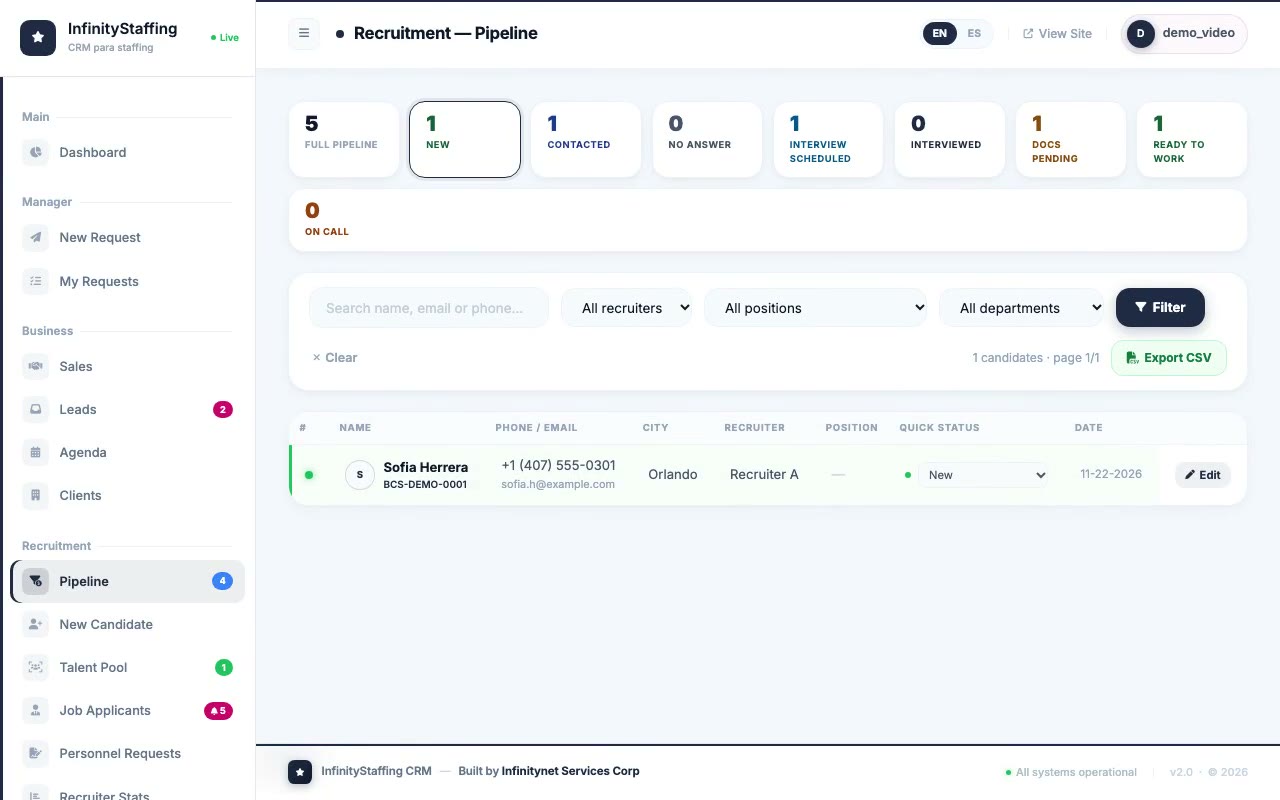
InfinityStaffing replaces spreadsheets, scattered emails and paper forms with one workflow. Every candidate, client and employee has a record in the database, and every change is logged.
Candidates and prospects reach the CRM directly, without emails or manual entry.
Each candidate moves through clear stages, with an owner and notes.
Prospects, clients and the follow-up calendar, from the first call.
Intake, assignment and exit of every employee, with full history.
Documents and history stay organized for audits and daily work.
Business numbers by recruiter and by client, without building reports by hand.
Three short walkthroughs of the CRM areas, with demo data.
A tour of the whole CRM, from first contact to exit.
Candidate pipeline, statuses, applicants and the talent pool.
Web leads, prospects, clients and the follow-up calendar.
Master list, staff intake, exits, complaints and reports.
Each user sees only what their role allows, and every action is recorded.
Each module is charged separately and integrates into one single system with the CRM: one login, one database, one set of data.
These are the processes where staffing teams usually lose the most hours. The figures come from a real operation; each company should measure its own times.
Where the hours go, and how much comes back.
Real example: InfinityStaffing. System volumes in production, monthly average from September to November 2026. The "before" minutes are work assumptions, not measurements.
| Process | Cases/month | Before | With the CRM | Saved/month |
|---|---|---|---|---|
| Staff intake packets Paper, scan and copy to Excel | 36 | 45 min | 10 min | 21 h |
| Sales visits logged Wufoo + Excel + finding follow-ups | 200 | 5 min | 2 min | 10 h |
| Daily sales follow-up list Checked by hand in a sheet | 22 days | 10 min/day | Automatic, 7 am email | 7 h |
| Daily recruiting list Calls, follow-ups and interviews built by hand | 22 days | 20 min/day | Automatic, 7 am email | 7 h |
| Active / Inactive reports Pivot table in Excel | 4 | 60 min | 1 min | 4 h |
| Staff exits Read Wufoo, search, notify | 22 | 10 min | 1 min | 3 h |
| Staffing requests from clients Email or phone call | 15 | 15 min | 5 min | 2.5 h |
| Master list entry Typing the employee into Excel | 12 | 10 min | 1 min | 2 h |
| Job letters Drafting the letter in Word | 3 | 20 min | 3 min | 1 h |
| Employee complaints WhatsApp or call, no follow-up | 4 | 20 min | 7 min | 1 h |
| Estimated total | ≈ 59 h |
Conservative scenario: about 30 hours a month, if the old times were half of what we assumed. That is about 35% of a full-time job.
Roles and permissions decide which modules each person sees. Nobody sees more than they should.
Pipeline, applicants, talent pool and team statistics.
Web leads, prospects, clients and the follow-up calendar.
Intake, assignments, exits, complaints and time off for staff.
Control panel, reports and the audit trail for the whole team.
Enter how many candidates you process each month and how long each one takes you today. The result updates as you type.
Estimate based only on the numbers you enter. It is not a guarantee of results.
Public forms and QR links send candidates and requests straight into the CRM, with their data and documents.
Every candidate and staffing request moves through the pipeline, with statuses, notes and owners.
Intake, exits, complaints and statistics by recruiter, with an audit trail.
Tell us about your staffing company and we will schedule a demo with your operation.